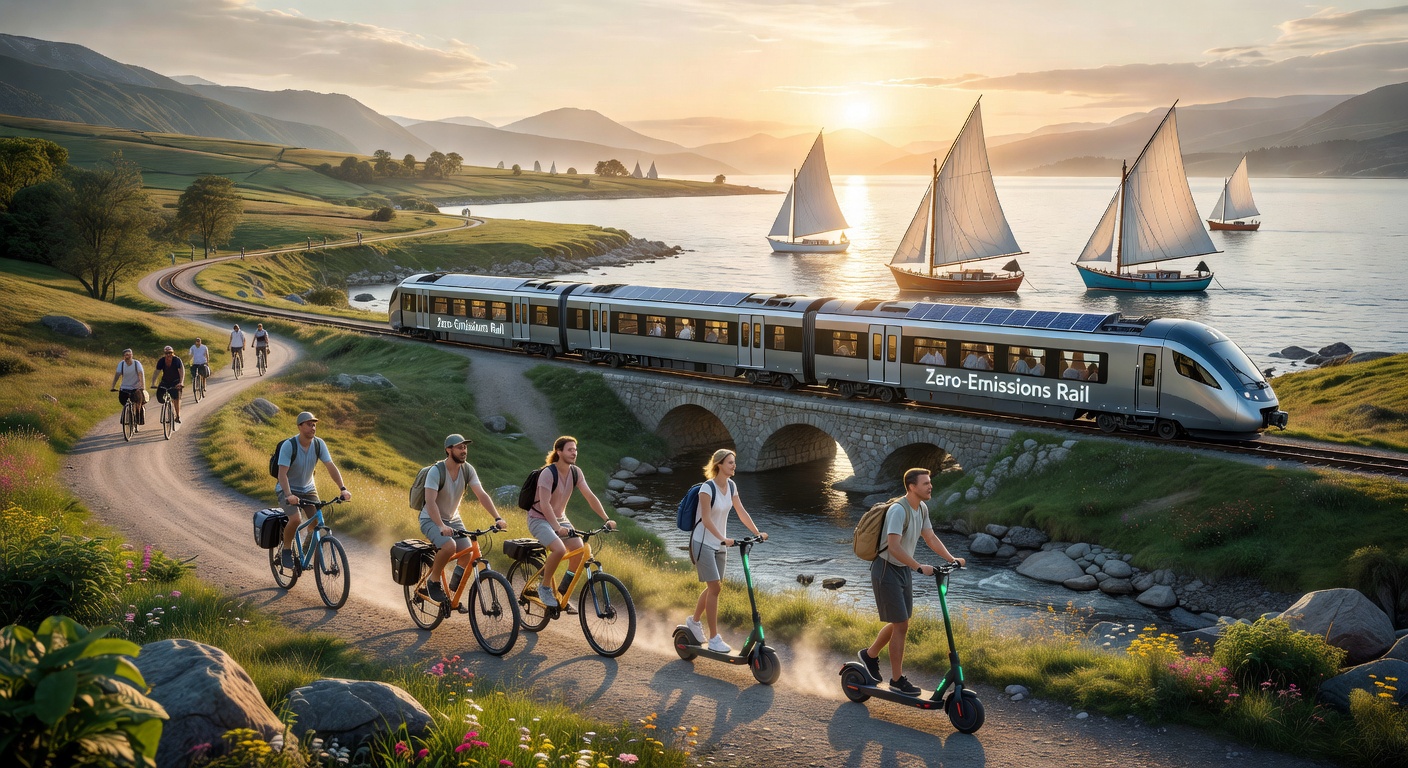
Getting There Without the Guilt
Transportation is the single largest contributor to your travel carbon footprint — but greener choices exist at every step of the journey.
Transportation is the single largest contributor to your travel carbon footprint — but greener choices exist at every step of the journey.
How you get somewhere matters as much as where you go. Transportation accounts for approximately 75% of total travel emissions for the average international tourist — with aviation responsible for the lion's share. But the story doesn't end there. Getting between cities, around regions, and within destinations also adds up in ways most travelers overlook. This guide breaks down the real numbers and gives you practical, tested strategies to dramatically reduce your transport footprint without limiting your adventures.
A return flight from London to New York produces roughly 1.7 tonnes of CO2 per passenger — more than the average person in many developing nations emits in an entire year. A train journey covering the same route via Eurostar and ship produces around 95% less.
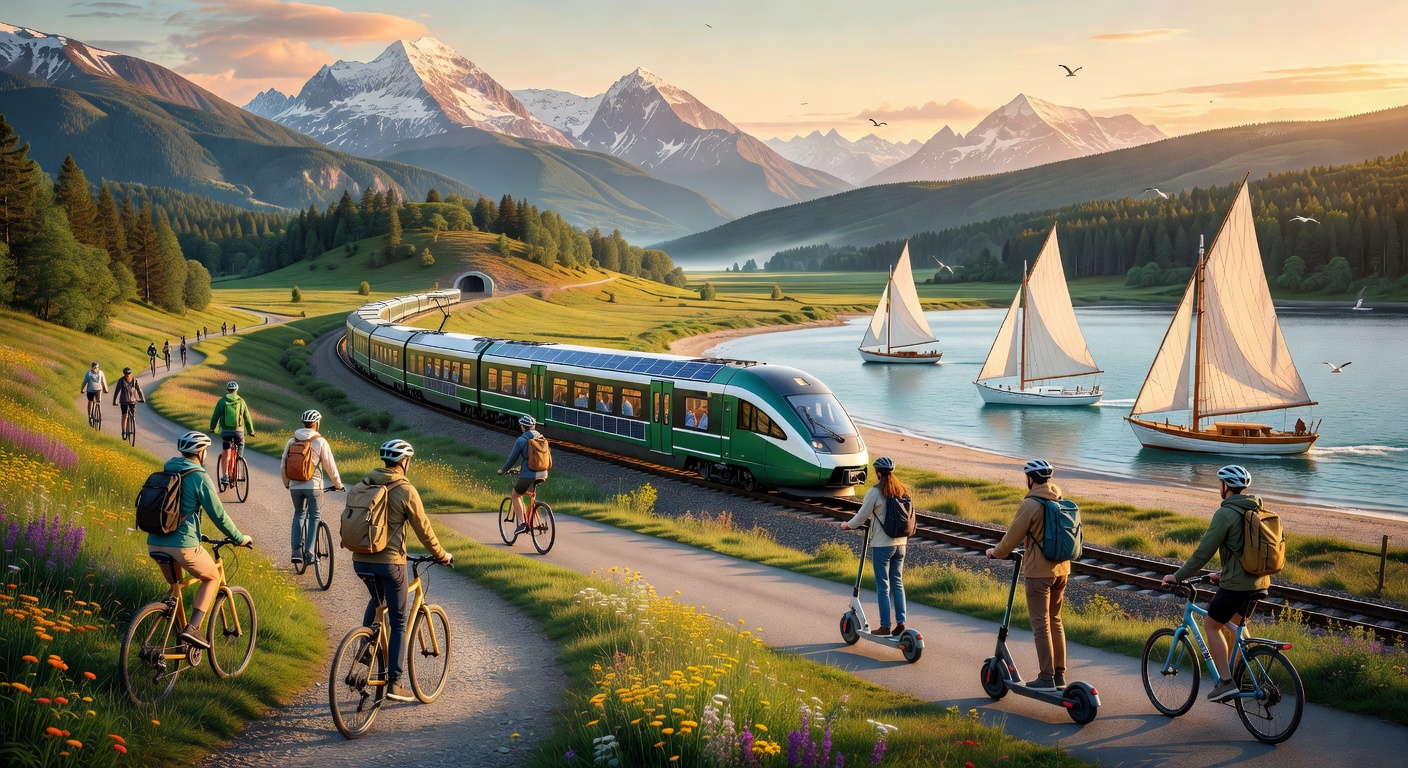
Slow travel isn't just an environmental strategy — it's a fundamentally richer way to experience the world. When you choose the overnight train over the budget flight, you wake up in your destination having watched the landscape transform, having slept well, and having generated a fraction of the emissions. Slow travel builds in the unexpected: the conversation with a fellow passenger, the unplanned stop at a roadside market, the village visible only from the window of a regional bus.
The philosophy draws from the "slow food" movement — a rejection of convenience as the supreme value in favor of depth, connection, and mindfulness. Applied to travel, it means extending your time in fewer places, choosing transport modes that let you be present in transit, and treating the journey as part of the destination rather than an inconvenience to be minimized.
Studies consistently show that slow travelers report higher levels of satisfaction and more meaningful encounters with local culture than those who pack multiple destinations into short windows. Combined with a dramatically lower carbon footprint, slow travel represents the clearest alignment of ethics and enjoyment in modern tourism.
CO2 emissions per passenger per kilometre — the definitive comparison to help you make informed choices.
| Transport Mode | CO2 (g/km/passenger) | Relative Impact | Best For | Key Limitation |
|---|---|---|---|---|
| High-Speed Train | 6–14g | Journeys up to 1,200km | Infrastructure availability | |
| Long-Distance Coach | 27–30g | Budget regional travel | Slower journey times | |
| Electric Vehicle | 35–50g | Group trips, remote areas | Grid carbon intensity varies | |
| Petrol Car (Shared) | 60–80g | Flexible, rural exploration | Emissions vary by occupancy | |
| Economy Class Flight | 133–255g | Long intercontinental legs | High emissions, radiative forcing | |
| Business/First Class | 370–700g | — | 3–9× higher than economy | |
| Bicycle / E-Bike | 0–8g | Urban and short distances | Limited range |
The CO2 figures above are a conservative measure only. Aviation also has a "radiative forcing" effect — contrails and high-altitude NOx emissions warm the atmosphere at roughly 2–4 times the impact of CO2 alone. The real climate impact of flying may be 2–4 times the g/km CO2 figure shown above.
Actionable choices you can make right now to reduce your travel footprint at every stage of your journey.
For any journey under 6 hours by train, the rail option is almost always lower-carbon and increasingly comparable in total travel time when you factor in airport procedures. Europe's Interrail and Asia's rail networks make multi-country trips by train not just viable but deeply rewarding.
If flying is unavoidable, make each flight count. Instead of multiple short trips, commit to fewer destinations for longer periods. Eliminating one long-haul return flight can reduce your annual carbon footprint by 1.5–3 tonnes — equivalent to planting 75+ trees.
Takeoff and landing account for the majority of fuel burned per flight. A direct long-haul flight is substantially more efficient than two shorter connecting legs covering the same total distance. Always choose non-stop routes when comparing flight options.
Overnight trains serve double duty: they move you between destinations while you sleep, eliminating hotel costs and airport waiting time. Routes like the Caledonian Sleeper in Scotland, the Nightjet network in Europe, and the Shinkansen night services in Japan offer genuine comfort at low environmental cost.
Local buses are among the most carbon-efficient forms of motorized transport and the most authentic way to experience a destination. They connect you to communities, markets, and viewpoints that tourist transport bypasses entirely — and the serendipity-to-cost ratio is unbeatable.
Most city activities happen within cycling distance of central accommodation. Renting a bicycle or using a city bike-share scheme for urban exploration generates zero emissions, costs almost nothing, and provides a completely different perspective on a city's rhythms and neighbourhoods than any other mode of transport.
When driving is necessary, platforms like BlaBlaCar, Kangaride, and local Facebook groups facilitate ride-sharing with other travelers. Filling a car distributes the per-km emissions across multiple passengers — a full four-person vehicle matches or beats a regional train in CO2 per passenger kilometre.
When hiring a car is necessary for reaching remote natural areas, choose the most fuel-efficient option available. EVs charged on renewable-heavy grids (Iceland, Norway, Costa Rica, New Zealand) produce near-zero operational emissions. Always ask rental companies about their fleet sustainability commitments.
Carbon offsets are not a magic solution, but high-quality programmes can play a meaningful role when flying is genuinely unavoidable.
The first principle of carbon offsetting is: reduce first, offset the residual. No offset programme eliminates the atmospheric warming from your flight — at best, quality offsets fund projects that remove equivalent carbon elsewhere. The quality gap between offset programmes is enormous, which is why certification matters.
The Gold Standard and Verified Carbon Standard (VCS) are the two most rigorous third-party certification frameworks. Projects certified under these standards must demonstrate additionality (the emission reductions wouldn't have happened without the offset funding), permanence, and measurability. Avoid uncertified "direct donation" offset schemes.
These organisations offer verified, high-quality carbon offsets with transparent project reporting and third-party certification:
The transport revolution is well underway. EVs, e-bikes, and electric scooters are transforming how travelers navigate destinations with minimal environmental impact.
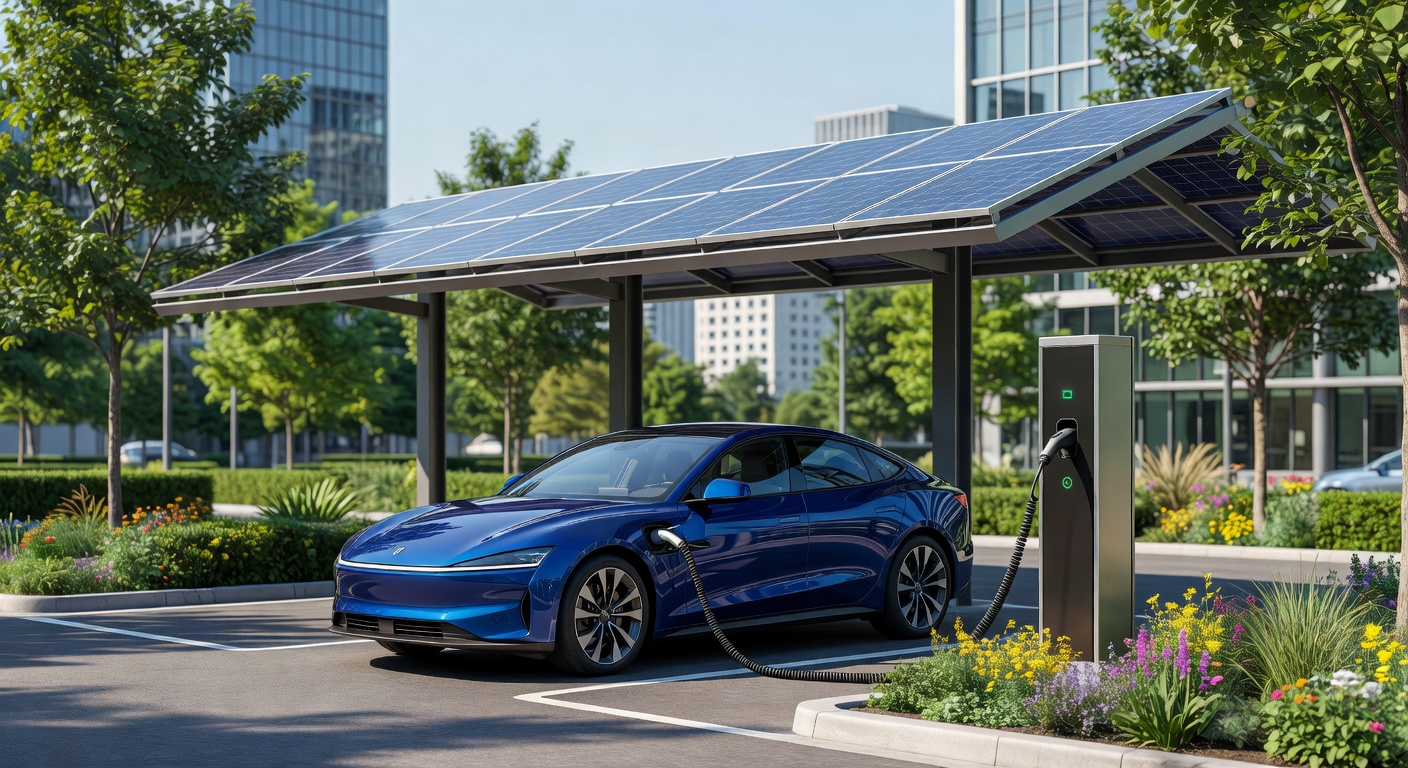
EV road trips have become genuinely practical across Europe, North America, New Zealand, and parts of Southeast Asia, with rapid charging networks expanding rapidly. Countries like Norway (100% EV sales) and Iceland (powered by 100% renewables) make EV road trips effectively zero-emission. Apps like PlugShare and A Better Routeplanner make charging infrastructure easy to navigate.

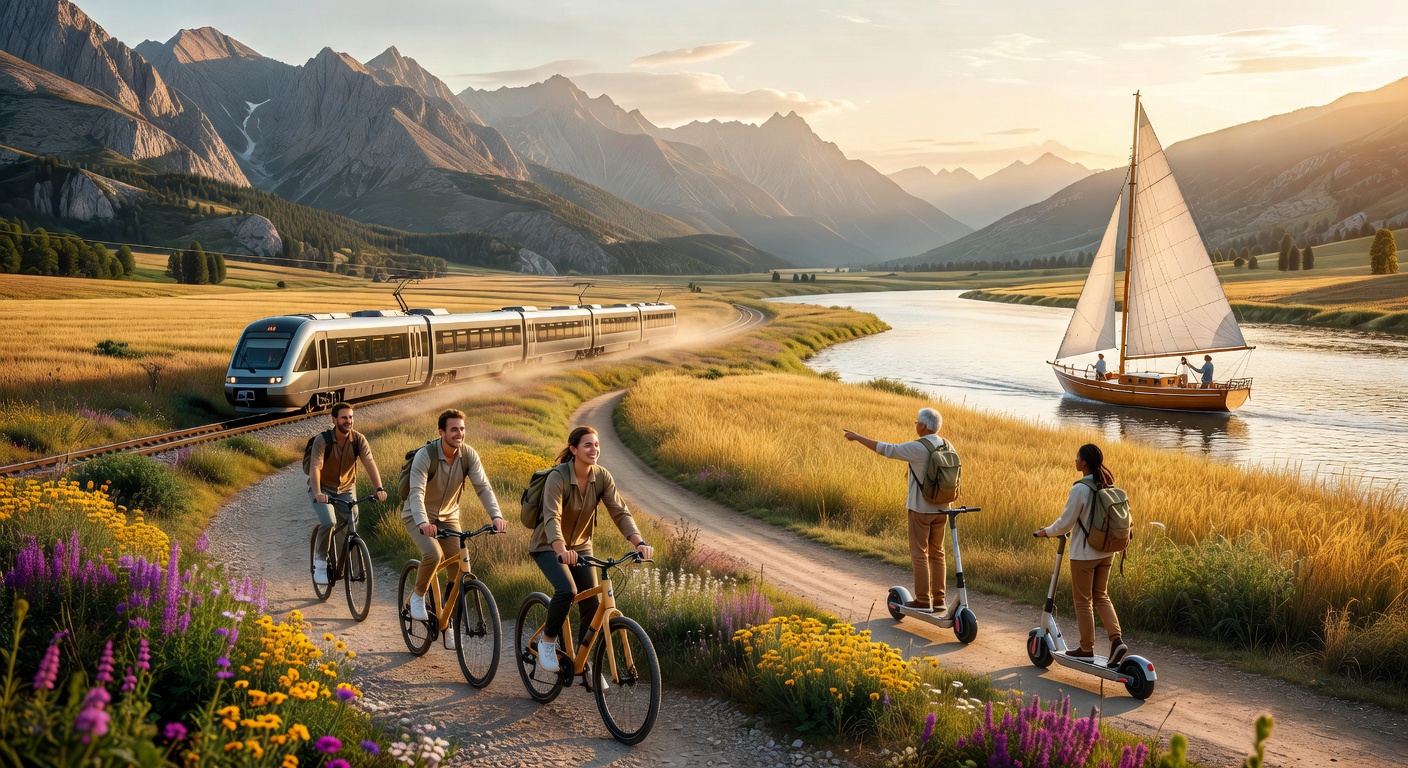
E-bikes have democratised cycling for urban exploration, making hills, distances, and heat less prohibitive. City bike-share schemes are now available in over 800 cities worldwide. For travelers in cities like Amsterdam, Copenhagen, Kyoto, and Portland, cycling isn't just the greenest option — it's genuinely the fastest way to get around during peak hours.
Your in-destination transport choices accumulate significantly over a multi-week trip. Here's how to navigate like a local — and like a responsible traveler.
Urban rail systems are among the lowest-emission transport options available. Buy a multi-day pass on arrival and default to underground or tram networks for all trips under 10km.
Kayaks, rowboats, and paddleboards offer immersive, zero-emission access to coastal and river environments. Many eco-destinations offer guided human-powered tours as their primary activity.
The simplest, most sustainable mode of transport also offers the deepest connection to place. Design your accommodation choice around walkability to maximise how much of each destination you explore on foot.
Electric scooter networks in cities across Southeast Asia, Europe, and Latin America offer a practical, low-emission alternative to taxis for distances of 2–15km. Check that operators use renewable energy for charging.
When taxis are necessary, opt for operators with hybrid or EV fleets. Apps like Bolt Green, Eco Cab, and Uber Green in major cities filter specifically for electric and hybrid vehicles in their fleet.
In some rural eco-tourism contexts, horse, mule, or donkey transport represents a genuinely low-carbon, traditional option — provided animal welfare standards are met. Research operator welfare practices before booking.